Prototype de PCB en toute simplicité

Service complet de prototypage de PCB personnalisé.

Surface Finishing

Bead Blast

Bead blast is a common surface treatment that propels abrasive particles onto a part's surface using high-pressure air, applicable in many industries such as automotive, aerospace, construction, and furniture.

Get a quote

Introduction to Bead Blast

Bead Blast
Bead Blast
Description

The part surface is left with a smooth, matte appearance.

Technical Properties

Applicable Sharp edges and burrs Premium appearance availability Tolerances
Metals, Plastics Removed Yes Met after surface finish

Example of a Bead Blast Part

Bead Blast
Bead Blast

CNC Bead Blasting Finish Gudie

1. Principle of the Bead Blasting Process

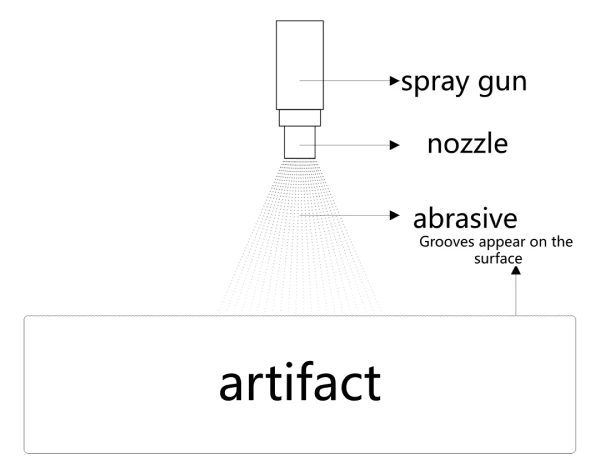
Bead blasting uses compressed air to propel abrasive beads at high speed onto the surface of a workpiece. The impact of the beads removes surface contaminants and creates a uniform matte texture with the desired surface roughness. Bead blasting can improve surface cleanliness, enhance the adhesion of subsequent coatings, remove minor machining marks, and create a consistent decorative finish. It is commonly used for CNC-machined aluminum, stainless steel, copper, and other metal parts.

Bead Blasting Process Principle

2. Bead Blasting Media

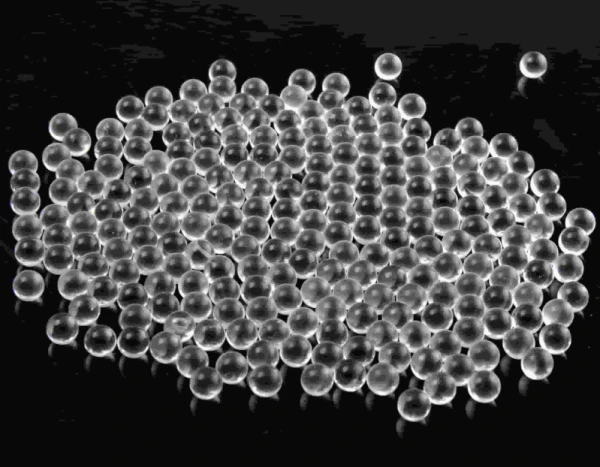
Glass beads are the primary abrasive media used for conventional bead blasting of CNC parts. Compared with more aggressive abrasives, glass beads provide a relatively gentle and uniform surface treatment, making them suitable for both cosmetic finishing and light surface cleaning.
Glass beads are commonly used for aluminum, stainless steel, copper, and other metal parts where a fine, uniform matte finish is required. The final appearance depends on factors such as bead size, blasting pressure, blasting distance, and processing time.

Bead Blasting Media
Glass Beads

3. Bead Size and Mesh

The size of the glass beads directly affects the surface texture, roughness, and overall appearance of the finished part. For conventional CNC bead blasting, commonly used glass bead sizes include 80 mesh, 100 mesh, and 120 mesh.
In general, a higher mesh number indicates finer abrasive particles, which produce a finer and more uniform surface texture.

For conventional CNC bead blasting, 100 mesh glass beads are used as the standard specification. Depending on actual blasting capacity and production requirements, 120 mesh may be used. Unless otherwise specified, the abrasive mesh should not be lower than 100 mesh.

Bead Size and Mesh
Glass Bead Mesh Size Particle Size Typical Surface Effect
80 Mesh Coarse More pronounced texture and relatively higher surface roughness
100 Mesh Medium Uniform texture with a good balance between surface appearance and processing efficiency
120 Mesh Fine Finer texture with a softer and more uniform matte appearance

4. Bead Blasting Methods

Bead blasting can be performed using different equipment configurations. Common methods include suction-type dry bead blasting, pressure-type dry bead blasting, and wet bead blasting.

4.1. Suction-Type Dry Bead Blasting

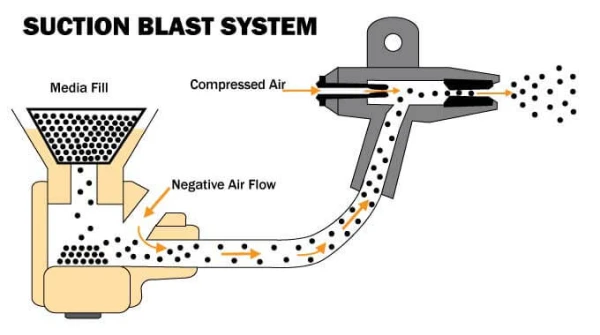
A suction-type dry bead blasting machine uses compressed air to create negative pressure inside the blast gun. This negative pressure draws glass beads into the gun through the media hose. The compressed air then accelerates the beads and propels them through the nozzle onto the workpiece surface.
In this system, compressed air provides both the media feeding force and the jet acceleration force.

Suction-Type Dry Bead Blasting

4.2. Pressure-Type Dry Bead Blasting

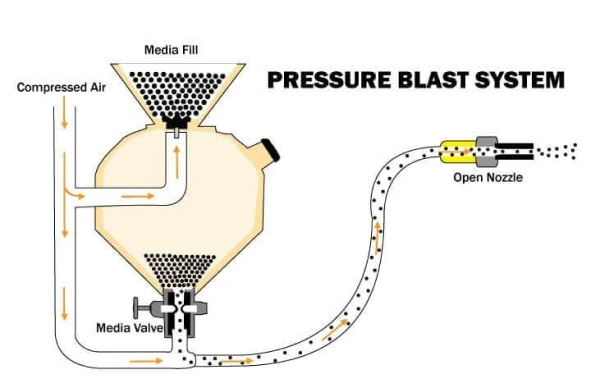
A pressure-type dry bead blasting machine stores glass beads in a pressurized vessel. Compressed air pressurizes the vessel and forces the glass beads into the media hose. The beads are then further accelerated by compressed air and discharged through the nozzle onto the workpiece surface.
Compared with suction-type systems, pressure-type bead blasting provides more direct media delivery and is suitable for applications requiring higher blasting efficiency or more consistent surface treatment.

Pressure-Type Dry Bead Blasting

4.3. Wet Bead Blasting

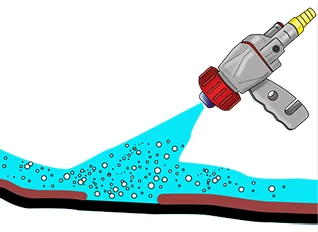
Wet bead blasting uses a mixture of glass beads and water as the blasting medium. A slurry pump delivers the mixture to the blast gun, while compressed air accelerates the slurry and propels it through the nozzle onto the workpiece surface.
Wet bead blasting can reduce dust generation and provide a relatively smooth and uniform surface finish. It is suitable for applications where surface quality and process cleanliness are important.

Wet Bead Blasting

5.Bead Blasting Finish Classification

Finish Grade Common Glass Bead Size Typical Texture Effect Common Applications
Fine Soft-Matte Blasting Fine glass beads Very fine and uniform texture with subtle surface grain and a clean, refined appearance High-end electronic housings, precision medical parts, instrument housings
General-Purpose Bead Blasting Medium glass beads, typically 100 mesh Balanced matte texture with a uniform appearance and moderate surface roughness; suitable for stable batch production Consumer electronics accessories, stainless steel decorative parts, conventional CNC cosmetic parts

6.Characteristics of Brushed Metal Finish

Bead blasting is widely used for surface cleaning and cosmetic finishing of CNC-machined metal parts. By controlling the glass bead size and blasting parameters, different levels of matte texture and surface roughness can be achieved.

  • Surface Cleaning: Removes light oxidation, dirt, oil, and machining residues from the workpiece surface.
  • Machining Mark Reduction: Helps reduce the visual appearance of minor machining marks and creates a more uniform surface texture.
  • Matte Surface Finishing: Produces a consistent matte or satin-like appearance on aluminum, stainless steel, copper, and other metals.
  • Surface Preparation: Creates a suitable surface condition for subsequent processes such as painting, powder coating, and other finishing treatments.
  • Cosmetic Finishing: Improves the visual consistency of CNC-machined parts and provides a clean, uniform appearance.
  • CNC Part Finishing: Commonly used for electronic housings, equipment enclosures, mechanical components, decorative metal parts, and other CNC-machined products.